FAQs - For you
These FAQs are intended for teams implementing IntelliProve in their solution. For end-user-facing questions, refer to FAQs - For your end users.
Getting started
For teams evaluating or implementing IntelliProve
Most teams complete an initial integration—performing Face Scans and visualizing Health Insights—in less than one day. Developers can refer to the Developer docs for step-by-step guidance on embedding IntelliProve into their solution.
After setting up your first MVP, we recommend refining the user journey to fully leverage the value of Face Scans and deliver a meaningful, long-term experience for your end-users. This typically includes:
- Identifying where Face Scans fit best within your product and the user journey
- Recommending follow-up actions and feedback loops based on the Health Insights
- Designing flows that highlight progress over time
To support this, IntelliProve offers a range of tools—from IntelliWidgets for quick, modular insights to our Rest API for accessing raw data that can power your recommendation engine, notification system, feedback loops or analytical workflows.
During the integration process, we provide full support to help you reach a successful launch.
Yes, it is possible to white label IntelliProve. For solutions that want a seamless experience, internally and externally, IntelliProve is the perfect option.
Face Scans will be an integral part of your offering, without the need to refer to a third party.
IntelliProve's API provides a comprehensive response containing all available biomarkers. It allows you to manually select the specific biomarkers you want to use and determine their optimal use. This level of customization empowers you to personalize your solution even further.
Product use & integration
Questions about how to use and integrate the product
A typical Face Scan takes about 20 seconds to measure qualitative biomarkers.
Biomarkers can easily be linked to your specific offering. In general, the value of a certain biomarker (or combination of biomarkers) defines which part of your offering is recommended to your user. Clear examples:
- Low Acute Mental Stress Score values serve as the starting point to introduce preventive stress-relieving activities.
- High ANS balance values and low Morning Readiness scores can guide the user towards vitamins and food supplements for energy and fatigue.
- Low Resonant Breathing Scores indicates the user could benefit from relaxation exercises focused on respiration.
IntelliProve provides a ready-made mechanism specifically to recommend your content based on the users personal health insights: the Recommendations widget.
Additionaly, check out the 'How can it be used?' sections of every biomarker and health metric on our product documentation.
There are various ways to use IntelliProve's health and well-being biomarkers within your online solution:
- Biomarker values can be displayed directly to the user. For example, every biomarker value is displayed on a tile in a dashboard.
- Biomarkers can be used as input for your own graphs, charts or health scores.
- The result of the biomarkers can be given to your user textually.
- The biomarker values can serve as input to personalise the content you are offering. This content can be vary various: from audiovisual content to health exercises, from elements in healthcare pathways to mental health/well-being sessions.
All biomarkers are measured during a Face scan and represent a unique objective snapshot of that moment of time. By conducting frequent measurements, a trend/progress over time can be obtained.
To determine health metrics, our models use data spanning over multiple days or weeks. This is because our models have been trained to make a prediction based on a trend over time.
Science and technology
Questions about the technology, how it works and how it's been validated
The evaluation of the performance of the algorithms is performed by step-by-step comparative analyses with the current state-of-the-art medical devices (pulse oximeter, sphygmomanometer,…) or questionnaires (e.g. PHQ-9, GAD-7). The accuracy and precision are checked by calculating for example the Mean Absolute Error (MAE), Mean Squared Error (MSE), Root Mean Squared Error (RMSE) and Correlation Coefficient (R).
Currently, more than 1 million datapoints (resulting from various collaborations with clinical organisations) are actively used for testing and validating our models.
We kindly refer to our validation and precision report for an in-depth analysis on how our software is tested and validated. In short, the accuracy and precision levels of our product can be found in the table below.

IntelliProve makes use of photoplethysmography (PPG), an optical method to measure cardiac-synchronous blood volume change in body extremities such as the face, fingers and earlobes. As the heart pumps blood, the volume of blood in the arteries and capillaries changes by a small amount in sync with the cardiac cycle. This change in blood volume in the arteries and capillaries underneath the skin leads to small changes in the skin colour (visible in the Red/Green/Blue spectrum), from which a PPG waveform is estimated.
Traditionally, the PPG signal is captured using a device (e.g. pulse oximeter) that emits light and measures the amount of light that is absorbed or reflected by the tissue. In our approach, we use ambient light from the environment (the light source) and the camera from a smart device (the sensor) to measure the ‘remote’-PPG. The face serves as the region of interest due to its thin tissue and optimal blood perfusion.
Relying on modern computer vision technology, facial dynamics and microexpression patterns can be detected and extracted, reflecting the hemifacial asymmetry in emotion expressions. This makes it possible to objectively detect and predict mental disorders, such as anxiety or mood disorders.
Typical patterns are raised eyebrows, leaden gazes, swollen faces and hang-dog mouth expressions.
Heart Rate Variability, or HRV for short, is a non-invasive measure of your autonomic nervous system, which is the body’s main control center. It is widely considered as one of the best objective metrics for physical fitness and determining your body’s readiness to perform. HRV is literally the variance in time between the beats (NN interval) of your heart.
Heart rate variability (HRV) can be derived from a ECG or PPG signal. A commonly used statistical metric for representing short-time HRV (over a time duration of the order of 10s to 1 min) is the Standard Deviation of NN intervals (SDNN).
The intimate connection between the heart and the brain is well described. HRV is known to be regulated by the prefrontal cortex (i.e., brain regions involved in the regulation of ANS activity). It is considered to indirectly reflect complex patterns of brain activation and provides information on the central nervous system (CNS) functional organization and the bidirectional interaction between the CNS and the ANS. There is substantial evidence that HRV is not only a risk marker for cardiovascular disease, but that also decreases in HRV have close associations with depression, schizophrenia, and post-traumatic stress disorder. On the other hand, high HRV is generally associated with a relaxed and resilient mental state.
While we often associate biomarkers with physical illness, it is crucial to recognize their relevance in assessing mental well-being as well. We kindly refer to our comprehensive blog post about the use of biomarkers and how they can give professionals unique insights from a patient and provide valuable information for personalized care and treatment plans.
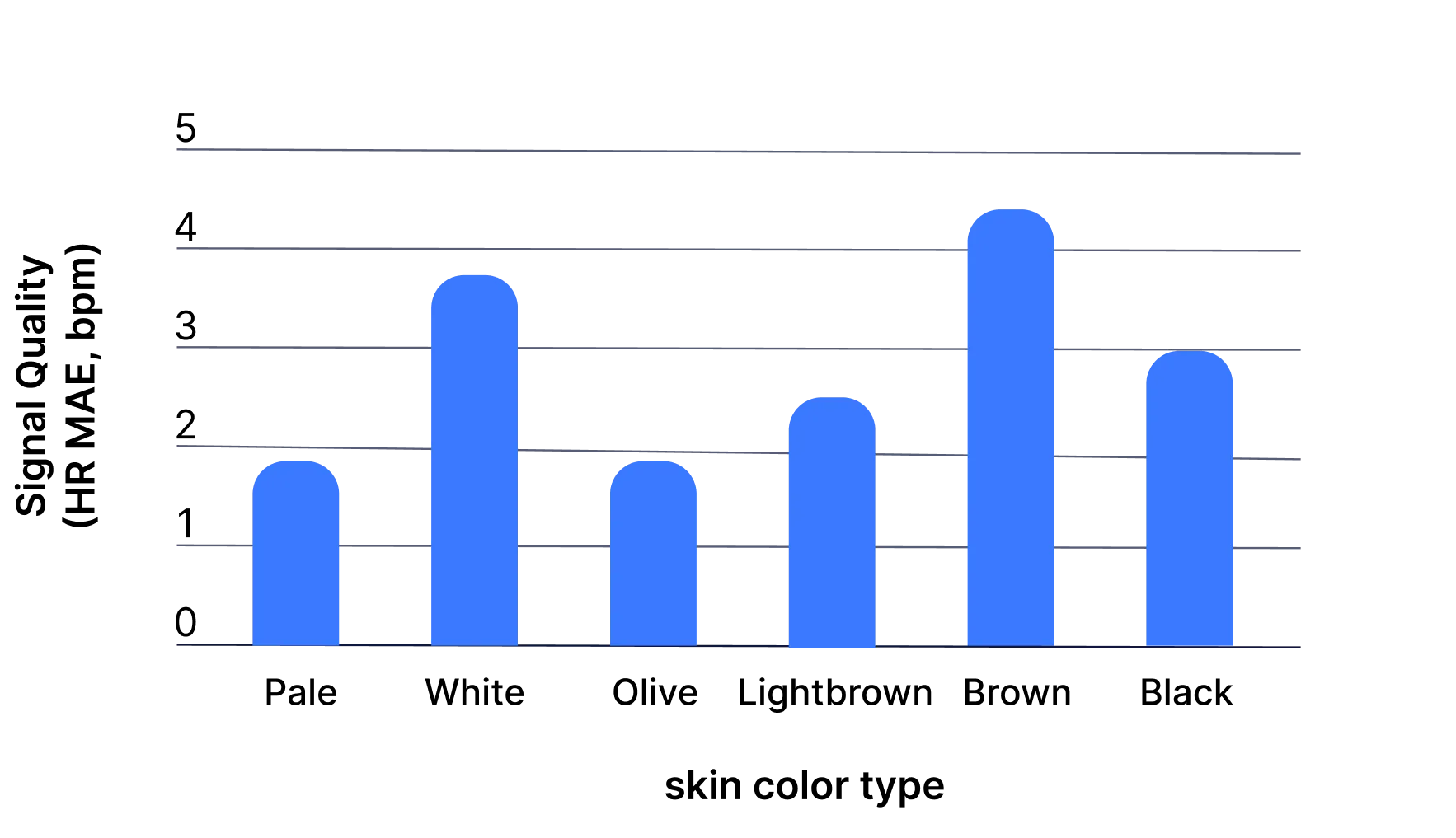
At IntelliProve, ensuring the effectiveness of our product across the population is a top priority. Due to continuous training and testing of our model with test subjects with different skin colours, no reduced performance can currently be observed in people with a dark skin colour.
To illustrate, the graph below represents the margin of error of the heart rate (which is a direct derivative of our signal quality) in the function of skin colour. The smaller this margin of error, the greater the signal quality. For each group, this margin of error remains nicely below the threshold of 5bpm (=clinical acceptability criteria). We kindly refer to our validation and precision report for more infomation.
Product positioning and user guidance
One of the significant advantages of our API offering is the complete customization of the returned values and follow-up based on the preferences and logic of the platform itself. Our clients employ various methods to interpret the measured values, some concrete examples are:
- Presenting absolute values with color coding to indicate low (e.g. green), medium (e.g. orange), or high levels (e.g. red).
- A dashboard with the biomarkers as tiles. Users can click a biomarker icon, whereafter a banner pops-up with qualitative information accompanied by recommendations to improve or maintain the current wellbeing state.
- Using a single aggregated score or graph that includes numerical or visual indications of benchmark values.
In our documentation portal, you can find definitions, examples of color coding, and qualitative information for each value bracket. In addition, during a short workshop (offered as part of our product), you will be guided in the interpretation of the biomarker according to your specific solution.
Your Health Metrics (such as stress and fitness level) combine both objective data, subjective data and other context to give you a complete picture of your wellbeing. Intelliprove provides insights across multiple areas:
How objective and subjective data work together:
Each metric combines three types of data:
- Objective physiological measurements: Heart rate variability, stress indicators, and other biomarkers measured via the facescan
- Subjective self-reported data: Your answers to questions about how you're feeling, your sleep quality, energy levels, mood, and daily experiences
- Details about you, such as your age and sex.
By combining these perspectives, Intelliprove creates a more complete picture than either measure alone could provide. Your body's physiological signals may detect patterns before you consciously feel them, while your subjective input adds important context about your lived experience.
Intelliprove is designed to align objective and subjective data. When there's a significant discrepancy between how you feel and what your physiological measurements show, you'll see a bar instead of a single score point.
If you feel good but your scan shows concerning physiological signals, your body may be detecting stress, poor sleep recovery, or declining fitness before you consciously notice it. This gives you the opportunity to take action early, before issues become problems you can feel.
Conversely, if you feel unwell but your measurements look healthy, this might indicate temporary factors or that your body is actually coping better than you realize.
Learn more about how your MetricsMetrics are calculated.
The positioning depends on your specific use case, but there are some general principles that apply across most implementations.
For enterprise customers
IntelliProve helps organizations offer employees simple, preventive health insights they would otherwise not have access to. It reaches people who may not proactively monitor their wellbeing and shows, as an employer, that you invest in wellbeing with concrete and innovative tools—not just policies or statements. The result is a more engaged workforce and a clearer understanding of wellbeing trends within the organization.
For end-users
Most people only consult a healthcare professional when symptoms become noticeable. Yet indicators like increased stress, elevated blood pressure risk, or reduced sleep quality can build up without being immediately felt. IntelliProve offers a quick, accessible check-in—on your own time, without an appointment. It is not a diagnostic tool, but it provides helpful indicators that support awareness and early action, such as noticing rising stress patterns, shifts in energy balance, or changes in sleep-related signals. The following article provides more insight into the importance of preventive health.
We use a communication approach designed to support users without creating unnecessary worry. Any less optimal result is framed as a signal to pause and reflect, not as a critical warning.
- No negative labels We avoid terms like “bad” “dangerous” or “concerning”. This ensures results are never presented in a way that feels judgmental or alarming.
- Positive and action-oriented guidance When a score is elevated, we describe it as a point of attention or an opportunity to take proactive steps. The focus is on what users can do, not on what might be “wrong.”
- Focus on trends, not single measurements Insights are communicated in the context of patterns over time, rather than one-off results. This reduces the impact of natural day-to-day fluctuations and encourages users to look at the bigger picture.
- Self-comparison, not comparison with others All insights are relative to the user’s own baseline, never to other individuals or populations. This avoids feelings of inadequacy and keeps progress personal and empowering.
This approach helps keep Face Scan results supportive and motivating, enabling users to build awareness without adding pressure or negative feelings.
IntelliProve can be a strong engagement tool that increases participation in preventive health. However, its value for corporate wellbeing goes further.
- Early, objective physiological data The Face Scan provides objective indicators such as heart rate variability and stress-related signals. These can highlight early signs of imbalance that users may not consciously notice. In many cases, such signals appear weeks or months before employees experience subjective complaints or consider consulting an occupational health physician.
- A data-driven ally for preventive care IntelliProve is not only an engagement tool; it is a data-driven support instrument that can strengthen the preventive capabilities of wellbeing at work health teams. It helps identify trends early and provides additional context that may support proactive wellbeing initiatives.
- Transparency through validation Sharing IntelliProve’s validation report can help build trust, as it demonstrates the scientific basis and reliability of the physiological measurements.
- Collaboration with research and care institutions IntelliProve collaborates with organizations such as Wit-Gele-Kruis and TU Delft on validation and research, supporting continuous improvement and scientific rigor.
Compliance and regulatory
Yes. IntelliProve is built on a security-first architecture and operates within a fully certified information security management framework. All data is encrypted at rest and in transit, and is completely pseudonymized. This means no direct link to identifiable people exists on our systems. ISO 27001–certified security management IntelliProve’s Information Security Management System (ISMS) is certified to ISO 27001, the leading international standard for information security. This ensures that our technical, organizational, and procedural controls are independently audited and meet globally recognized security requirements. Upon request, we can provide:
- Our ISMS scope statement
- A copy of our ISO 27001 certificate
What is CE Marked? IntelliProve has a CE-marked Class I medical device covering its core signal acquisition engine: the technology that extracts physiological signals (e.g., rPPG) from facial video. This CE-marked device relates specifically to the validated signal extraction component. What about the Face Scan? Our commercially available wellness product, which includes the Face Scan, is powered by the same underlying technology. However, the commercially available product is positioned and intended as a wellness solution and is not a medical device. Under EU MDR (2017/745), software qualifies as a medical device only if it has a medical intended purpose (Article 2(1)). The currently available Face Scan product does not have such a medical intended purpose and is therefore not CE-marked as a medical device. Furthermore, the Face Scan plug-in displays values like HRV, subjective health questions, and goes beyond just measuring physiological signals. It provides lifestyle-oriented insights for self-awareness and trend monitoring. It does not provide diagnosis, therapeutic recommendations, or clinical decision support. In your communication, it is important to therefore not refer to the Face Scan as a medical device, but as a wellbeing solution.
What this means for you You are using a wellness solution built on technology that has been developed and validated under medical device standards. You benefit from the quality standards, clinical validation, and rigorous processes that come with medical device certification, but in a configuration that's appropriate and fully compliant for wellness applications.
We provide several layers of assurance to demonstrate that IntelliProve meets the highest standards of privacy, security, and regulatory compliance. GDPR-compliant by design Our platform is designed to meet all applicable GDPR obligations, including data minimization, pseudonymization, purpose limitation, and strict access controls. We process only the minimum data required for the service and apply strong privacy protections to every stage of the workflow.
Refer to our Privacy policy for measures that IntelliProve has taken to ensure complete pseudonymization of the data. Our Data Processing Agreement (which includes our list of subprocessors) is available upon request. Please email [email protected] for more information.
Certifications and compliance
IntelliProve operates fully in line with GDPR requirements and within an ISO 27001–certified Information Security Management System. We also develop under ISO 13485 (medical quality management) and hold CE Class I certification.
Upon request, we can provide:
- our ISMS scope statement
- a copy of our ISO 27001 certificate
These documents help legal and privacy teams verify our governance framework.
Complete pseudonymization
All data processed by IntelliProve is fully pseudonymized.
- Each measurement is referenced only by a unique ID with no direct link to personally identifiable information.
- The video stream used for the measurement is never stored.
- Only the calculated biomarker results are stored, and these are maintained in a fully pseudonymized format.
Transparent documentation
We provide a detailed Privacy Policy that explains exactly how data is collected, processed, and secured. Legal teams can also review our complete privacy documentation, including our Data Processing Agreement.
IntelliProve develops software that extracts health-related insights from short facial videos. The system uses classical algorithms along with AI to process inputs and infer outputs. As such, our technology falls within the broad scope of the EU AI Act, which applies to AI systems placed on or used within the European Union. IntelliProve applies AI in a controlled and supportive role. AI is used to assist with feature extraction and research and development activities, but not for end-to-end, fully automated decision-making. Our products do not perform automatic decisions based on AI, nor is the interpretation of results generated by AI. Core parts of the system rely on validated algorithms, with human oversight throughout development, validation, and deployment. Beyond internal assessments, IntelliProve has already completed extensive preparatory work for the AI Act. This includes:
- A structured internal AI risk assessment
- An independent external AI risk assessment conducted by a specialized third party
- The implementation of an internal AI Management System (AIMS) to govern all AI-related activities
- Alignment of AI governance with our existing ISO 27001-certified security and risk management framework
These measures were taken proactively, ahead of formal legal obligations, to ensure clarity on impact, responsibilities, and future development choices.
Yes. We design and develop our platform in alignment with WCAG 2.1 Level AA, which is widely regarded as the appropriate standard for professional, interactive and health-related digital applications. Across the platform, WCAG AA serves as our structural target. Some components — such as our new main health widget — already meet WCAG AA requirements in full. Other parts of the application are actively being improved to further align with these guidelines as part of our ongoing product development. What does this mean in practice? In practice, this results in a platform that is designed to be accessible, usable and understandable for a broad range of users, while remaining clinically accurate and user-friendly. Depending on the component, accessibility features include: Keyboard accessibility and screenreader support Semantic HTML to ensure correct interpretation by assistive technologies Sufficient colour contrast and visual redundancy, so information is never conveyed by colour alone Scalable and responsive interfaces that remain usable when zoomed or resized Contextual guidance, such as tooltips and explanations, to support comprehension For more complex interactions — such as camera-based face scans — accessibility is approached with care. These flows require active user positioning and movement, which introduces specific technical challenges for full inclusivity. We continuously evaluate and iterate on these components to improve accessibility where technically and clinically responsible.
👉 Not in the list? Don't hesitate to send your question to [email protected] and we will get back to you with an answer as soon as possible.